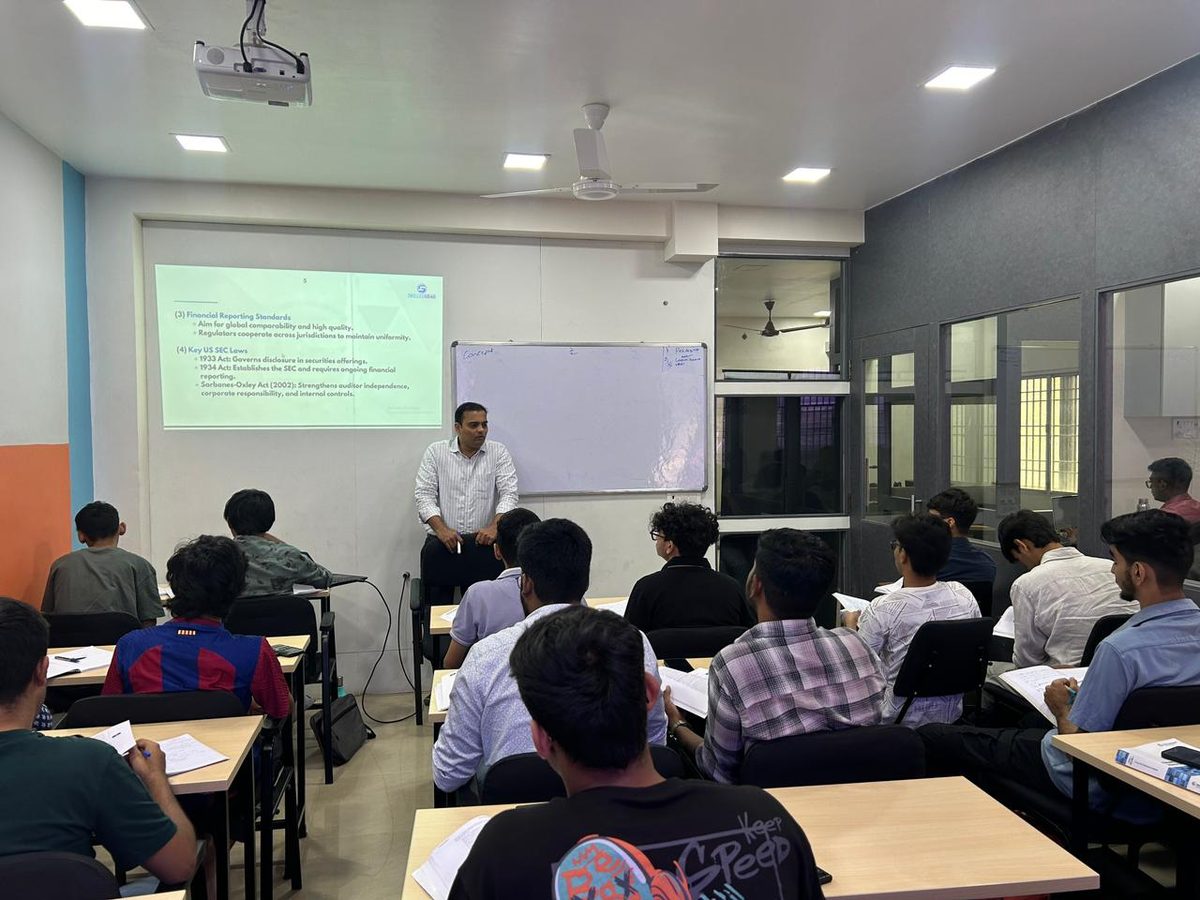
ACCA suits anyone targeting a global career in accounting, audit, finance or advisory, especially at Big 4 firms (Deloitte, PwC, EY, KPMG), global banks and MNCs. It also works well for students who want a globally recognised alternative to CA India. SkilledGrad teaches ACCA in Chennai at our Purasaiwakkam and Tambaram centres and through live online batches.
How does ACCA compare to CA India?
ACCA is recognised globally in 180+ countries while CA India is primarily recognised within India. ACCA has a higher pass rate per paper and can be completed faster, primarily because there are no group structure and you can write one paper at a time. Both are rigorous, and will require substantial effort from the students.
How many papers can I clear in a year?
ACCA exams run four times a year, in March, June, September and December, and you can attempt up to four papers per sitting. Realistically most students clear 3 to 4 papers a year depending on study hours and background. SkilledGrad faculty help you plan the optimal schedule.
What is the eligibility for ACCA?
You need to have completed 10+2 (or equivalent) with at least 65% in English and Maths/Accounts. You will be eligible for exemption based on the graduation you choose. We would recommend that you reach out to us before you enrol for graduation to get the maximum exemption benefit.
Does SkilledGrad provide ACCA study materials?
Yes. SkilledGrad is an ACCA Gold Approved Learning Partner, so we use official ACCA learning materials along with question banks, mock exams and revision packs. All digital study materials are included in the course fee.
What are the ACCA exam fees?
ACCA sets its own fees and revises them, so we do not reprint numbers that go stale. There is a one time registration fee, an annual subscription for as long as you stay a student, an exemption fee for each exam you skip, and an exam fee per exam that rises with level and with how late you book. Current figures are on
ACCA's fees page for India. These are separate from SkilledGrad coaching fees, and we help you plan which exams to attempt per sitting to keep the spend down.
Can I do ACCA straight after 12th?
Yes. Direct entry after 12th generally requires around 65% in Maths or Accounts and in English, with 50% in remaining subjects. Like mentioned earlier, you will be eligible for exemption based on the graduation you choose. One thing to know for 2027: the Digital Tech and Innovation module and every Strategic Professional element cannot be exempted, whatever your degree. We would recommend that you reach out to us before you enrol for graduation to get the maximum exemption benefit.
I'm from an arts or science stream, not commerce. Can I do ACCA?
Yes. Arts and science students typically enter through the FIA route rather than direct entry, then continue into the main qualification. There is no requirement to have studied commerce at school. The Knowledge exams, Financial Accounting, Management Accounting and Financial Accounting, are designed to build from the ground up, and SkilledGrad's Chennai batches teach them from first principles.
How many ACCA paper exemptions will I get?
It depends entirely on what you have already completed. As a guide: 12th pass gets no exemptions and sits every exam; a general B.Com typically attracts up to 4, leaving around 9; a B.Com from an ACCA-accredited or integrated programme can attract up to 9; BBA is typically around 4; a qualified Indian CA can receive up to 9, leaving the Strategic Professional level. Three things students consistently get wrong: exemptions are not free, as you pay ACCA a fee per exempted paper and it is sometimes not worth claiming; exemptions from an integrated degree require that specific programme to be accredited, so a general B.Com from a non-partner college does not qualify; and you can decline an exemption and sit the paper anyway, which is occasionally the right call if it underpins later material. Send us your marksheet and we will tell you your exact paper count.
What does ACCA cost in India, in total?
Approximately ₹1.7 to 2.2 lakh self-studying, rising to roughly ₹3 to 4.5 lakh with coaching, spread across the qualification. The components are a one-time registration fee, an annual subscription payable every year you remain a student, an exam fee per paper (cheaper in the early entry window), exemption fees per exempted paper, and coaching and materials. Two cost traps specific to Indian students: ACCA fees are set in GBP, so your rupee cost moves with the exchange rate; and the annual subscription runs every year you are registered, including years you sit no exams. Students who drift and take five years instead of three pay several extra subscriptions for nothing.
Can an ACCA sign audit reports in India?
No. Under Section 141(1) of the Companies Act, 2013, only a Chartered Accountant holding a Certificate of Practice from ICAI is eligible for appointment as a statutory auditor of an Indian company, and the same restriction applies to tax audit under the Income Tax Act, 1961. This is the single most important limitation to understand before enrolling. What ACCA does give you in India is recognition with the Big 4 and multinational employers, particularly for IFRS-facing roles, along with roles in financial reporting, management accounting, internal audit and consulting within MNCs and GCCs, plus genuine portability across 180+ countries. If your goal is to run an audit practice in India, CA is the qualification. If your goal is a finance career inside multinationals or work abroad, ACCA is a legitimate and often faster route.
ACCA or CA. Which is better for a student in Chennai?
Different qualifications for different outcomes. Both start after 12th, but ACCA is 11 exams over a typical 2 to 3 years with higher paper-by-paper pass rates and no mandatory articleship (a flexible 36-month experience requirement instead), while CA runs Foundation, Inter and Final over a typical 4 to 5 years with lower pass rates and a structured mandatory articleship. CA carries statutory signing authority in India; ACCA does not, but is recognised across 180+ countries. ACCA suits students targeting MNCs, GCCs, Big 4 advisory, IFRS roles or eventual work abroad. CA suits students wanting audit practice in India or maximum recognition with domestic employers. Chennai and Coimbatore have a growing base of multinational finance operations, which is the specific reason ACCA demand has risen in Tamil Nadu.
Two to three years is realistic for a focused student, or 3 to 4 years from 12th to full membership including the experience requirement. ACCA holds four exam sessions a year, in March, June, September and December, so you are never waiting long for the next attempt, and you may sit up to four papers per session, though most students who attempt four do worse than those attempting two or three. Membership also requires the 36 month Practical Experience Requirement and the Ethics and Professional Skills module, both of which can run in parallel with exams. One deadline to know: once you sit your first Strategic Professional exam, a seven year limit applies to completing that level. SkilledGrad plans each student's sitting schedule around these constraints.
What salary can an ACCA fresher expect in India?
Published fresher ranges cluster around ₹4 to 8 lakh per annum, with the wide spread reflecting a real difference between Big 4 or MNC entry roles and smaller firms. Be careful with figures you see online. Several coaching sites publish numbers at the top of the range, or quote member salaries as though they were fresher salaries. A realistic expectation for a fresh ACCA affiliate in Chennai is the lower-to-middle end of that band, rising materially within three to five years.
Where can I write ACCA exams in Chennai?
ACCA exams are computer-based and delivered at approved centres, with locations in Chennai across all four annual sessions. Confirm the current centre list on ACCA Global when you book, as venues can change between sessions.
Can I study ACCA while doing my degree or a full-time job?
Yes, and most Indian candidates do. Alongside a degree is the easier option and arguably the best time to do it; align your exam attempt with a gap in your semester calendar. Alongside a full-time job, budget 12 to 15 hours a week and expect to attempt fewer papers per session. The failure pattern in both cases is the same: deferring. SkilledGrad runs weekday evening and weekend ACCA batches at both our Purasaiwakkam and Tambaram centres in Chennai, plus live online, specifically so that studying alongside work or college stays realistic.
What happens if I fail a paper?
You re-sit the paper at any of the four annual sessions and pay the exam fee again, with the seven year rule applying only at Strategic Professional level. SkilledGrad students re-joining a paper are given the relevant revision sessions at no extra course fee.
 ACCA Gold Approved